
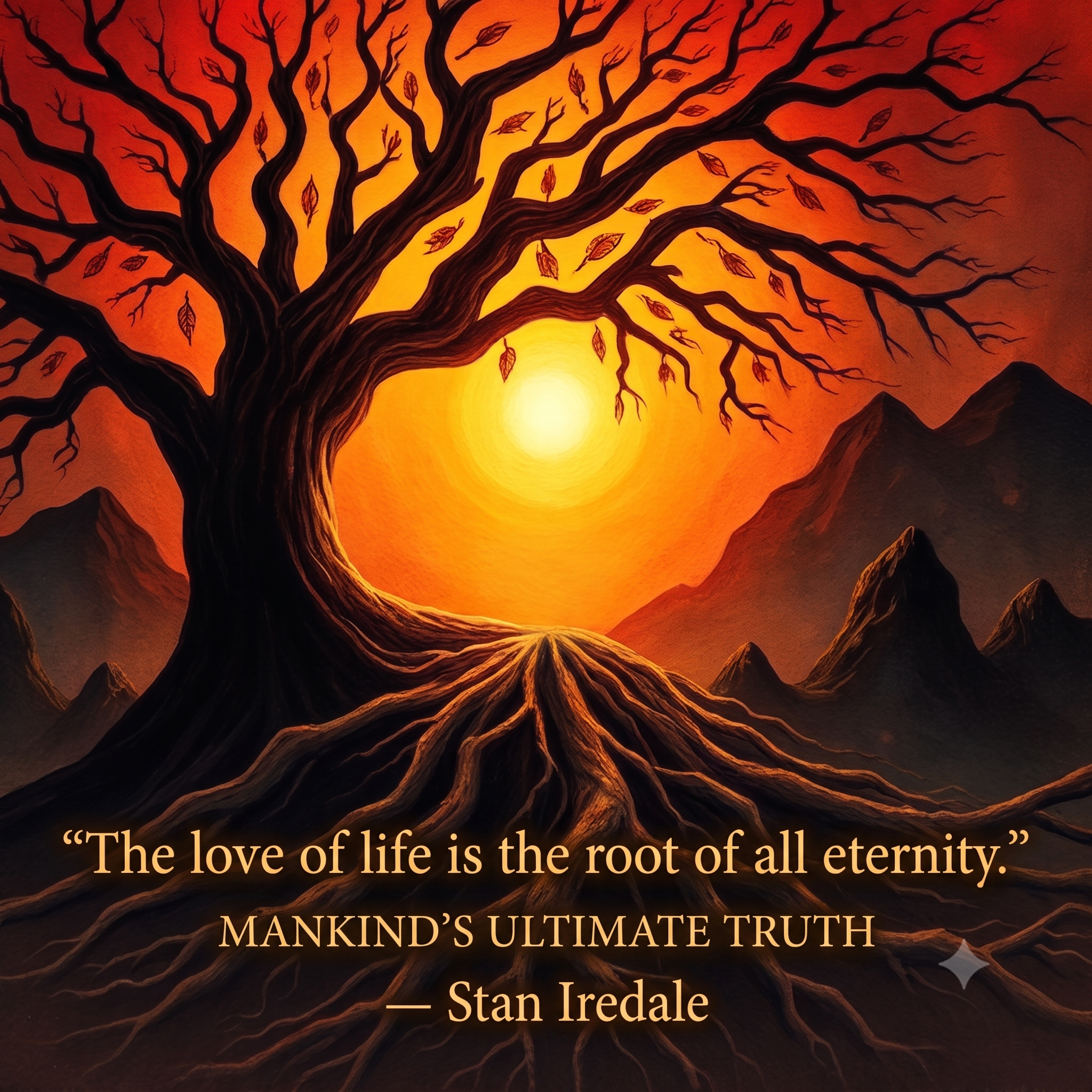

THE ROOT OF ALL ETERNITY
An Examination of Concrete Truth and Mankind’s Foundational Objective
Author: Stan Iredale
Date: July 2026
“THE LOVE OF LIFE IS THE ROOT OF ALL ETERNITY”
MANKIND’S ULTIMATE TRUTH
Throughout history, human civilization has institutionalized complexity. We have constructed vast systems of governance, convoluted legal codes, industrial economies, and competing theological frameworks, all in a persistent effort to articulate our place within the universe. Yet, when human existence is stripped entirely of its societal architecture, academic jargon, and theoretical noise, it collapses cleanly into a single, unyielding axiom. This baseline truth—immutable, self-contained, and universally binding—is that the love of life is the root of all eternity.
I. The Mechanics of the Unchangeable Baseline
In formal logic and pure mathematics, certain absolute fixed points exist independently of human consensus or empirical validation. A statement as elementary as 2 + 2 = 4 is not merely an observed fact; it is a concrete truth that remains locked in perpetuity across all possible circumstances. It requires no committee to defend it, no belief system to sustain it, and no essay to justify its existence. It simply is.
Human experience possesses an identical mechanical baseline. Every individual—from world leaders and industrial titans to the ordinary citizen and the newborn baby—is governed by the exact same elemental architecture: the raw, instinctual experience of existence and the fundamental, unyielding value of that existence. This primary drive is not an opinion, a theory, or a philosophy taught in schools. It is the core rule of life from which all human action originates. Every institution ever erected by mankind is ultimately a complex, often flawed mechanism designed to protect, manage, or interpret this simple foundational reality.
II. The Concrete Record of Reality
A concrete truth, by its very nature, is permanent. When an event occurs within the linear timeline of reality, it becomes an unalterable stitch in the fabric of existence. Whether an act is witnessed or forgotten, celebrated or buried by systematic denial, the historical fact of its occurrence remains completely unshakeable. This permanent footprint constitutes what can be understood as the unwritten, invisible, yet absolute history of reality—a natural mystic record.
This principle provides the definitive mechanical answer to the classical philosophical riddle of the tree falling in an empty forest. Academic evasion often suggests that without a sensory apparatus to process the impact into sound waves, the sound itself does not exist. This is an over-engineered attempt to escape the room of reality. The concrete truth is simple: the event occurred. The displacement of air, the impact with the earth, and the physical reality of the fracture are locked into history. It requires no human proof or validation to remain true. In exactly the same manner, the collective human experience—our struggles, our creations, and our profound moments of connection—remains permanently anchored in the universe, regardless of whether it is recorded or forgotten.
III. Defiance of Global Entropy
The physical universe operates under the mechanical certainty of entropy and chaos, colloquially recognized as Sod’s Law or Murphy’s Law: the principle that anything capable of breaking down or going wrong will ultimately do so. Left to its own devices, the material world moves inexorably toward decay, fragmentation, and silence.
Life stands as the sole, magnificent exception to this cosmic rule. Life is the singular force in the universe that actively defies entropy, taking a chaotic, breaking world and stubbornly forcing it to sustain itself, replicate, and continue. When the parameters are aligned correctly, life has no choice but to push forward; it operates with the same certainty that forces 2 + 2 to equal 4. The willful, stubborn passion for existence—the love of life—is the counterweight to universal decay. It is the permanent anchor that ensures human continuity, transforming transient biological moments into a lasting, unshakeable legacy.
IV. The Head Species and the Global Mandate
As the dominant species on this planet, humanity has assumed the immense responsibility of managing global resources, governing complex societies, and maintaining the biosphere. In the noise of modern geopolitics and environmental theory, this mandate is frequently treated as an abstract political debate or a shifting ideological duty.
When broken down into its simplest components, however, this planetary stewardship is revealed to be the direct, logical extension of the primary root. We do not look after the planet because of a rule written in a textbook; we look after it because we are alive and possess an inherent, collective code to preserve life. Without the foundational root of loving life, all systems of management, sustainability, and human organization lose their purpose and collapse into meaningless ash. The mandate to protect the planet is simply the practical execution of our species’ deepest, baseline truth.
Conclusion
Eternity is neither a distant spatial boundary to be discovered at the edge of the universe, nor is it an abstract mathematical timeline stretching endlessly into the future. It is a concrete reality grown from the ground up, anchored firmly by human consciousness in the present moment. By stripping away the superficial layers of complexity that dominate human discourse, we find the absolute, immovable foundation underneath.
Stan Iredale’s philosophy serves as a vital reminder that our deep, unyielding appreciation for existence is the very engine that sustains us, connects us, and keeps humanity permanently relevant in the vastness of time. The love of life is the root of all eternity—the simple, absolute fact from which all other truths grow.