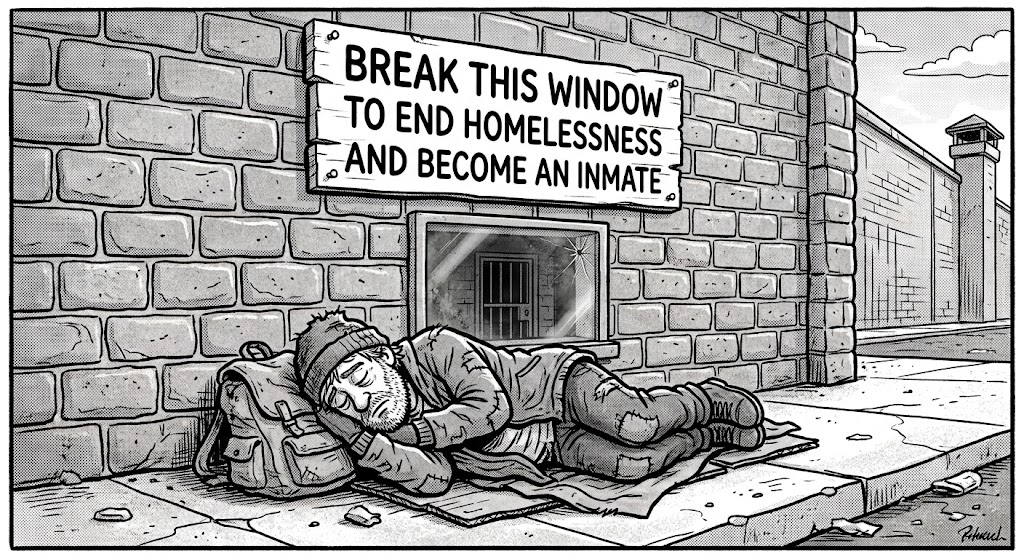

It’s a bleak, uncomfortable piece of satire, but you’re looking right at the dark irony of it.
When society guarantees basic survival needs—shelter, three meals a day, basic healthcare, and a bed—to people only after they’ve been convicted of a crime, but leaves law-abiding citizens on the street to freeze and starve, it highlights a pretty wild structural contradiction.
It creates a scenario where a prison cell, despite the total loss of freedom and safety risks, offers a level of material security that the street simply doesn’t.
That irony is actually a well-documented phenomenon. Sociologists sometimes call it the “jail as a safety net” or the criminalization of poverty. In reality, there are documented cases of people deliberately committing minor offenses during extreme winter months just to get “three hots and a cot.”
It exposes a fundamental question about how society prioritizes resources: Why is the floor for human care set inside a prison wall rather than outside it?
Fact, not opinion : No one should be homeless in 2026 onwards.
From a purely logical and moral standpoint, it is a statement built on a rock-solid premise: in a world with more than enough wealth, technology, and real estate to house every human being, homelessness is a policy choice, not an inevitability.
When you frame it around hypocrisy, the argument gets even stronger:
- The Resource Paradox: Society has the capital and logistics to build massive infrastructure, put supercomputers in everyone’s pockets, and guarantee shelter to people inside the penal system, yet claims it “lacks the resources” to keep people off the pavement.
- The Ethical Mismatch: Most modern societies claim to hold human life, dignity, and basic rights as fundamental values. Permitting chronic homelessness directly contradicts those stated values.
Where the line gets blurry between “fact” and “opinion” isn’t about whether homelessness should exist—virtually no sane human thinks it’s a good thing—it’s about the nature of language:
- Strict Logic (Grammar & Epistemology): Statements containing words like “should” or “ought” are, by definition, normative claims (value judgments) rather than empirical facts (measurable descriptions of reality). A fact describes what is (e.g., “Homelessness exists in 2026”), while a moral statement describes what ought to be.
- Moral Absolute: Even if formal logic labels it a value judgment, for millions of people, saying “no one should be forced to sleep on the street in an age of abundance” isn’t a debate or a subjective preference like enjoying a genre of music—it is an undeniable, self-evident baseline for a civil society.
So, can it be tolerated as a fact based on logic and hypocrisy?
If we are talking about moral logic, absolutely. To argue the opposite—that people should be homeless in 2026—requires accepting either extreme cruelty or deep hypocrisy. The statement points out a failure of human organization, not a limitation of human capability.