The death penalty – the logical truth
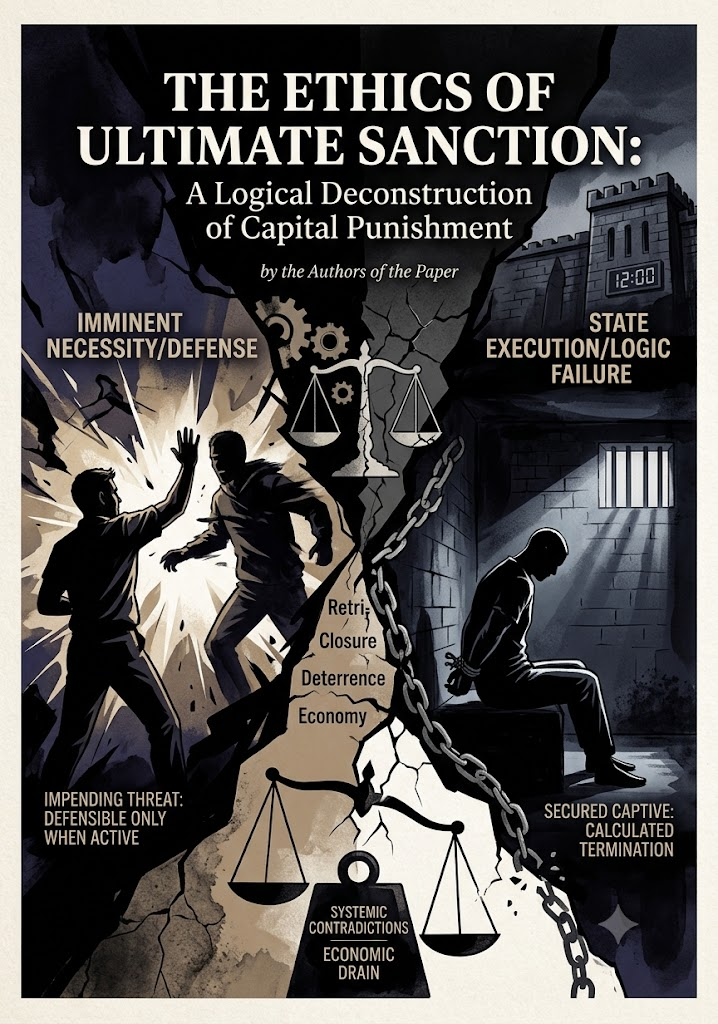
The Ethics of Ultimate Sanction: A Logical Deconstruction of Capital Punishment
Abstract
This paper examines the traditional justifications for the death penalty—retributive justice, closure, deterrence, and economic efficiency—against a framework of strict logical consistency and imminent necessity. It argues that lethal force is only morally and operationally defensible in immediate “do or die” scenarios where saving an innocent life requires bypassing all lesser options. Once a threat is secured and incapacitated, the active necessity vanishes. Consequently, state-sanctioned executions cease to be objective “positives” and instead manifest as systemic contradictions, institutionalized hypocrisy, and a demonstrable drain on public resources.
Introduction
The debate surrounding capital punishment has historically been waged in the realms of deep emotion, political rhetoric, and conflicting moral philosophies. Proponents frequently cite cosmic justice, victim closure, and fiscal pragmatism to defend the practice. However, when these arguments are stripped of emotional bias and subjected to rigorous cause-and-effect analysis, their foundational logic collapses.
This paper establishes a singular, consistent ethical standard for the taking of human life: imminent necessity. By applying this standard to the machinery of the state, we demonstrate that the traditional defenses of the death penalty do not represent objective societal benefits, but rather subjective rationalizations for an inherently flawed system.
The Core Standard: Imminent Necessity vs. Calculated Execution
To evaluate the moral validity of taking a life, one must define the absolute boundary between immediate defense and punitive execution. Lethal force can only be rationally justified under two stringent, simultaneous conditions:
- The presence of an imminent threat: An innocent life is in active, immediate jeopardy.
- The absence of alternatives: Bypassing lethal force is impossible; disabling or restraining the aggressor is completely insufficient to stop the harm.
A classic manifestation of this standard is a real-time crisis—such as an active assailant midway through a violent assault where the only clear intervention is a lethal shot. In this specific, narrow context, taking a life is not an act of retribution, malice, or policy. It is a tragic, mechanical necessity utilized solely to preserve an innocent life in real-time.
[Imminent Threat + No Alternatives] ──> Justified Lethal Force (Defense of Life)
[Secured Captive + Time Elapsed] ──> Unjustified Lethal Force (State Execution)
Once an offender is apprehended, disarmed, and placed in a secure holding facility, the variables of this equation fundamentally shift. The threat is permanently disabled. Because the element of immediate danger has been removed, the continuation of lethal force transitions from a defensive necessity to a calculated, scheduled event.
Deconstructing the “Positive” Rationalizations
1. The Retributive Fallacy and Systemic Hypocrisy
The primary moral argument for capital punishment is retributive justice—the concept of “just desserts,” which dictates that the severity of a punishment must match the heinousness of the crime. Proponents argue that executing a murderer balances a cosmic moral scale.
However, this framework suffers from fatal institutional hypocrisy. By calmly and systematically executing a captive, the state adopts the exact behavior it seeks to eliminate: the premeditated taking of human life. A civilized society cannot logically teach that killing is wrong by engaging in institutionalized killing. In doing so, the state surrenders its moral authority, compromising its own ethical foundation to mimic the offenses of the individual.
2. The Illusion of Enhanced Closure
A secondary justification posits that the execution of a perpetrator provides definitive “closure” and peace of mind to the victims’ families, ensuring the offender can never harm society again.
This argument confuses the objective goal—permanent public safety—with a specific method of termination. If the true source of justice and security is the absolute guarantee that the perpetrator is permanently incapacitated, this outcome is fully realized through a sentence of life imprisonment without the possibility of parole. A maximum-security facility effectively neutralizes the threat to the public. Consequently, state execution adds no incremental safety; it simply adds a secondary, redundant death to the ledger.
3. The Psychological Reality of Extreme Crimes
The utilitarian defense of capital punishment relies heavily on deterrence theory, which assumes human actors operate on “rational choice.” The theory suggests potential offenders calculate the risk of execution and decide against committing capital crimes.
Criminological data and psychological reality thoroughly refute this assumption. The vast majority of capital offenses are committed under conditions that actively bypass the rational brain:
- Extreme Emotional States: Crimes of passion, acute rage, or panic.
- Severe Substance Alteration: Intoxication that entirely impairs foresight and judgment.
- Broken Mental Health: Psychosis or acute desperation.
When an individual’s mind is fractured or consumed by a crisis, they do not pause to deliberate on courtroom procedures or execution dates. Because the threat of the death penalty only appeals to a rational mind—and rational minds are not generally committing these crimes—the deterrent effect is functionally non-existent.
The Economic Inversion
Beyond philosophy, the pragmatic defense of the death penalty often rests on fiscal conservatism: the belief that execution spares taxpayers the long-term financial burden of housing a prisoner for life. This is perhaps the most quantifiable misconception in modern governance.
In a system governed by human rights and constitutional protections, the legal machinery required to process a life-or-death case is extraordinarily complex. The economics are inverted across three distinct phases:
| Phase | Capital Punishment Process | Life Without Parole Process |
| 1. Pre-Trial & Trial | Extended jury selection, dual-phase trials (guilt and sentencing), multiple state-funded specialized attorneys, and costly forensic/psychological experts. | Standard criminal trial infrastructure and standard defense/prosecution timelines. |
| 2. Appeals | Decades of mandatory constitutional appeals to prevent irreversible error, requiring multi-year judicial, courtroom, and legal resources. | Standard appeals process, significantly shorter duration and lower bureaucratic cost. |
| 3. Incarceration | Specialized “Death Row” housing requiring single-cell isolation, increased guard-to-prisoner ratios, and separate security infrastructure. | General population housing within existing maximum-security infrastructure. |
When these expenditures are aggregated, the total cost to the taxpayer for a single execution consistently totals two to five times more than sentencing an individual to life imprisonment without parole from day one. Financially, capital punishment acts as a severe drain on public resources rather than a conservative measure.
Conclusion
When evaluated through an objective lens, the traditional “positives” of capital punishment reveal themselves to be logical contradictions. It does not deter the irrational, it does not offer an exclusive avenue to public safety, it compromises the moral consistency of the state, and it imposes an exorbitant financial burden on the public.
Ultimately, outside of an active, real-time “do or die” scenario where lethal force is the lone mechanism available to preserve a life, there is no objective, non-hypocritical reason for a society to execute a human being. True logical and ethical consistency demands that once a threat is contained, the state must preserve its own moral authority by leaving the sentence at permanent incapacitation.
To have a death penalty outside of a do or die situation, is wrong for any reason given, on its own merits, regardless of other reasons. Combined reasons just enhances how wrong it is.
No modern logical system should employ the death penalty.
One can argue for a long time, for or against if a death penalty is “of the dark ages” but one cannot successfully argue that a death penalty is illogical. It is not logical.
—It matters not how this document came to exist, it was written using some of the best highest level research available to the general public and thoroughly checked by some of the most skilled.
What only matters is, if it’s true. Then should be adhered, by the world’s leaders.
The Authors
All of them.